

DJI FlyCart 100: heavy-lift transport by drone
24 March 2026 · Transport
DJI FlyCart 100: heavy-lift drone transport reaches a new level
With the DJI FlyCart 100, DJI is launching a new transport drone for professional operations. The system is designed for heavy loads, demanding environments and precise delivery missions. According to DJI, the maximum payload is up to 85 kg in dual-battery mode. This is complemented by a maximum flight distance of up to 12 km, an integrated parachute system and a new winch system for professional transport tasks.
Developed for professional transport missions
The DJI FlyCart 100 is aimed at organisations, companies and emergency responders who need to transport material to places where conventional vehicles or helicopters are not always the most economical or practical solution. In hard-to-reach terrain, on infrastructure projects, in energy supply, construction or the security sector, a powerful transport drone can open up new possibilities. DJI clearly positions the FlyCart 100 as a professional delivery platform focused on payload capacity, safety and efficiency.
High payload and strong flight performance
A key feature of the FlyCart 100 is its high transport capacity. DJI specifies a maximum payload of 85 kg in the dual-battery configuration. The maximum take-off weight is 170 kg. At a take-off weight below 149.9 kg, DJI states a maximum flight distance of 12 km, a maximum flight time of 14 minutes and a hover time of up to 12 minutes in dual-battery mode.
This is particularly interesting for professional applications, as it allows not only smaller deliveries but also heavy equipment, tools or supplies to be transported efficiently.
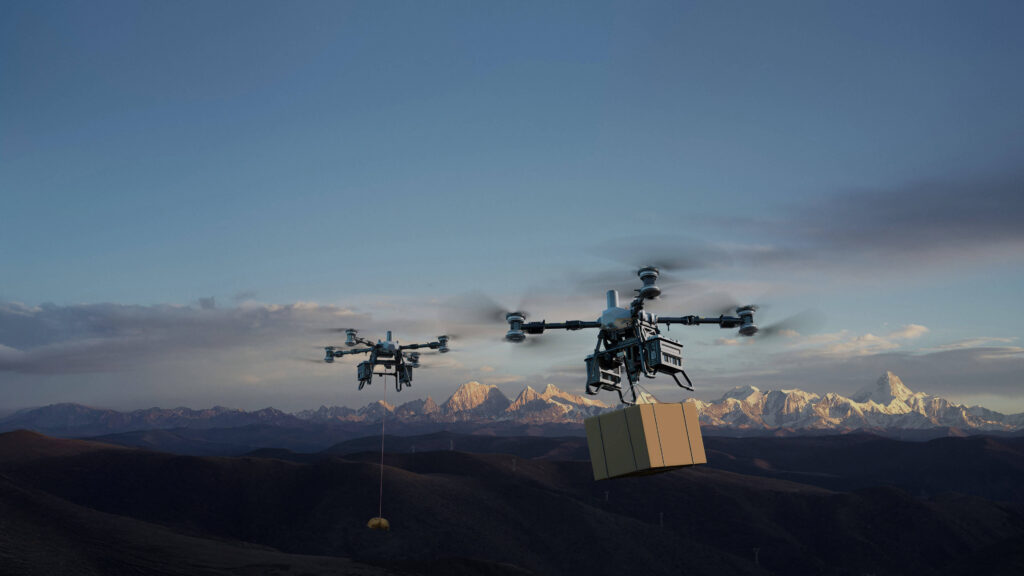
Winch and payload release for precise operations
Particularly interesting is the FlyCart 100’s new Flagship Winch System. According to DJI, the system offers a cable length of 0 to 30 metres. Supported features include a weighing function, active opening and closing of the hook via the app or a button, One-Tap Release and Retraction, and intelligent delay protection functions.
This makes the platform suitable not only for direct point-to-point transport, but also for operations in which material has to be lowered or picked up in a controlled manner without the drone itself having to land.
Focus on safety and sensors
With heavy transport drones in particular, safety plays a central role. DJI equips the FlyCart 100 with a comprehensive safety system. This includes LiDAR, radar-based front, rear and downward sensing, a quad-vision system and an FPV camera. According to DJI, the sensing range is up to 60 metres, although actual obstacle detection depends on environmental conditions such as light, rain, fog and the material of the obstacles.
An integrated parachute system is also fitted. DJI specifies a maximum landing speed of 7 m/s for the parachute. The system supports both manual and automatic deployment.
Built for demanding environments
The FlyCart 100 is designed for professional outdoor use. DJI specifies an operating temperature range of -20 to 40 degrees Celsius, an IP55 protection rating and wind resistance of up to 12 m/s. According to the specifications, the system also reaches a maximum service ceiling of 6000 metres above sea level.
In a country like Switzerland, with its alpine terrain, hard-to-reach infrastructure and challenging weather conditions, this combination makes the platform particularly interesting.
Modern transmission and professional system architecture
In terms of transmission and mission control, too, the FlyCart 100 is clearly designed for professional applications. DJI states a range of up to 10 km (CE standard) for the O4 transmission system, along with 1080p live view at 30 fps. 4G enhanced transmission is also supported. DJI also points to a new One-Stop Software Solution and integration into the DJI Delivery ecosystem.
This shows that the FlyCart 100 is not conceived as a standalone drone, but as part of a professional overall system for scalable delivery and transport processes.
Why the DJI FlyCart 100 is so exciting
The FlyCart 100 is not simply a larger drone. It represents a clear trend in the professional drone market: moving away from pure image capture towards concrete operational benefit. Wherever material needs to be transported quickly, precisely and without major ground effort, entirely new fields of application emerge.
These include, for example:
Construction and infrastructure projects in difficult terrain
Material transport in mountain regions
Supplying remote operation sites
Logistics for energy, security and rescue applications
Transport tasks where time, precision and accessibility are critical
Conclusion
The DJI FlyCart 100 shows where professional drone logistics is heading: higher payloads, more precise transport systems, powerful sensors and a clear focus on real operational requirements. For companies and organisations that see air transport not as a showpiece but as a productive tool, this system is particularly exciting.